

Industry Analysis of Education Consultancy in Nepal
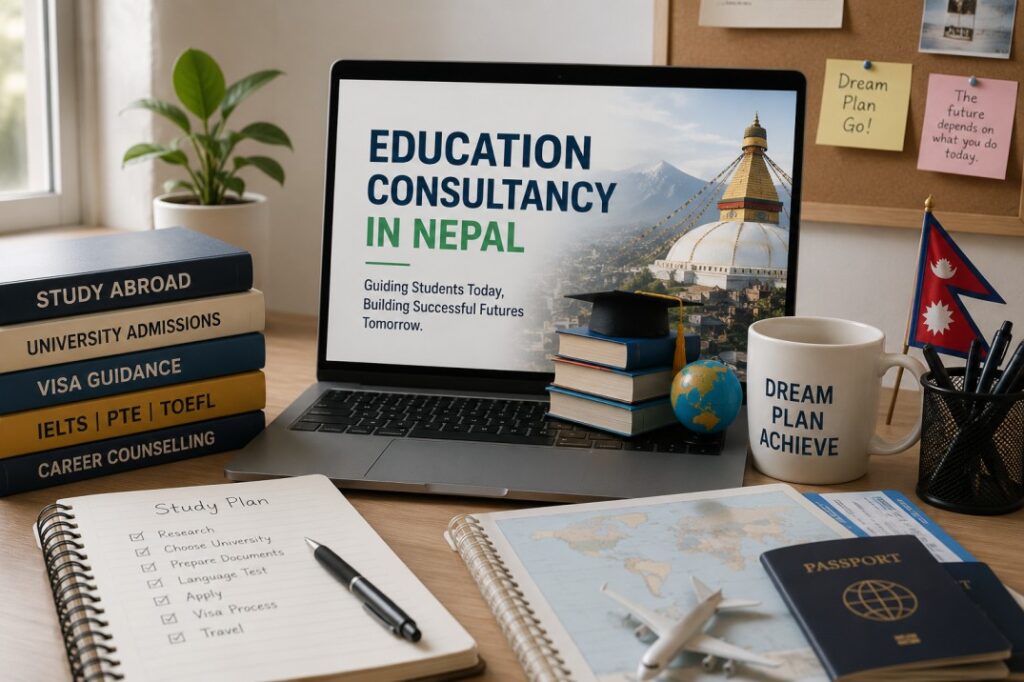
The education consultancy industry in Nepal has experienced rapid growth over the past decade due to the increasing interest of Nepalese students in international education and global career opportunities. The education consultancy industry mainly focuses on providing study abroad counseling, university admission support, visa processing assistance, and language preparation services such as IELTS, PTE, TOEFL, SAT, GRE, and foreign language classes. The growing trend of student migration for higher education has created strong business opportunities for education consultancies throughout Nepal, including emerging regional markets outside Kathmandu Valley.
Nepal sends a staggering number of students to universities abroad for higher education. According to the US Journal of Academics, there was an increase of 835% in Nepalese students pursuing study abroad between 2000 and 2017. Despite its tiny population, Nepal ranked 13 times higher than India, 6 times higher than China, and 4 times higher than Vietnam in terms of student mobility ratio, 12.3%, in 2016. Nepal also ranked as the second largest spending market in 2017 after India overall in the region for the United States, and an estimated 12,000 students were studying in the United States of America, which was a 20% increase in a year. According to the inbound insight article of Hannah Colbran, in 2022, there were 95,268 students who traveled abroad to study. Out of the entire number, 40,752 students headed to Australia (42.77%), 18,436 students headed to Japan (19.35%), 13,574 students went to India (14.24%), and 12,660 students headed to the USA (13.28%), and the rest of them went to popular destinations like the UK, Germany, Korea, Finland, and others. By the year 2025, the international study business is anticipated to be worth 1.5 trillion dollars. Despite its modest population and economy, Nepal is considered an established market for international students. Nepal is regarded as an important source for international students from top education destination countries such as the United Kingdom, the United States, Australia, Japan, Canada, China, India, and other European and Asian countries, resulting in a significant global presence for Nepalese students and Nepal becoming an important market for international students.
One of the reasons Nepalese students tend to go study abroad is because of the educational quality in Nepal, which has always been a matter of concern. As a result, considerable numbers of students choose universities abroad over Nepalese universities even if it brings huge financial problems that this implies. For decades the standards of teaching, facilities, and values have remained outdated in the context of the modern era of education. The curriculums in the universities of Nepal also do not match modern learnings and are based on centuries-old memorizing learnings, which leaves graduates with less practical knowledge and unskilled. Skill-based opportunities are rare to find, as the Nepalese educational system is affected by political instability, which is a deep-rooted problem of Nepal. Education is also manipulated by people in power.
Students get to work for limited hours since the foreign government allows it, so they can make money for themselves, be independent, and have the possibility of getting quality education and experience and the possibility of settling abroad. Foreign universities are also more suitable for Nepalese students, where they can study on a flexible schedule. Several countries that have great economies offer lucrative permanent residency (PR) rules, which are very appealing to Nepalese students. A post-study work visa after graduation is also one of the key factors for Nepalese students making the decision to study abroad. The Nepalese government also allows students to study overseas, which is comparable to labor migration and allows the government to worry less about jobs and job development in a country.
According to the Ministry of Education’s No Objection Certificate (NOC) branch data reported by Online Khabar, 51,637 students obtained NOCs within the first six months of the fiscal year 2023/24 for study abroad purposes. The report also identified Canada, Australia, Japan, the United Kingdom, and the United States as major educational destinations for Nepalese students. This increasing trend demonstrates the growing demand for international education services and study abroad consultancy support in Nepal. Similarly, recent reports published by The Kathmandu Post based on Sanothimi NOC branch data indicate that the number of NOCs issued has continuously increased over the years, reaching 98,997 in 2023, 106,881 in 2024, and 123,092 in 2025. The increasing number of outbound students reflects the expanding market size and business opportunities within Nepal’s education consultancy industry.
The financial scale of the study abroad market in Nepal is also increasing rapidly. According to Nepal Rastra Bank-related reports published by The Himalayan Times, approximately Rs. 47.71 billion was spent on study abroad payments during the first five months of fiscal year 2024/25. This indicates the strong economic size and growth potential of the education consultancy market in Nepal. The market characteristics of the education consultancy industry also indicate expanding regional business opportunities. Previously, education consultancy services were concentrated mainly in Kathmandu Valley. However, due to increasing internet accessibility, social media influence, educational awareness, and digital communication, demand for consultancy services has expanded significantly into regional cities such as Dhangadhi, Butwal, Pokhara, Chitwan, Nepalgunj, and Biratnagar. Students and parents now prefer accessing quality counseling and language preparation services within their own local area rather than repeatedly traveling to Kathmandu.
External Environment Analysis
The education consultancy industry in Nepal is highly influenced by various external environmental factors. Political conditions, economic trends, social behavior, technological development, legal frameworks, and environmental conditions significantly affect the operations, profitability, sustainability, and growth opportunities of educational consultancy businesses.
Since the industry primarily depends upon international education trends, student mobility, migration aspirations, digital communication, and international relations, changes in the external environment directly impact the performance of educational consultancy. Therefore, analyzing the macro-environmental factors through PESTLE analysis is important to identify the potential opportunities and threats affecting the business.
- Political Environment
- Economic Environment
- Social Environment
- Technological Environment
- Legal Environment
- Ecological Environment
Political Environment
The political environment significantly influences the education consultancy industry in Nepal because the industry is directly connected with government education policies, international diplomatic relations, visa regulations, and migration systems. Political instability, policy inconsistency, frequent government changes, and weak implementation of educational reforms have historically affected Nepal’s education sector and employment opportunities. As a result, many Nepalese students seek international education and career opportunities abroad, creating favorable market opportunities for educational consultancies operating in Nepal.
The Government of Nepal permits students to pursue foreign education through the No Objection Certificate (NOC) system under the Ministry of Education. The increasing number of NOCs issued by the government reflects growing institutional acceptance of international education mobility and rising student migration trends. This situation creates significant business opportunities for educational consultancy. Similarly, diplomatic relations between Nepal and major education destination countries such as Australia, the United Kingdom, Canada, the United States, Japan, and European countries positively influence student mobility and international education partnerships. Favorable visa policies, post-study work opportunities, and migration pathways in these countries further increase demand for educational consultancy services. However, the political environment may also create threats for education consultancy businesses. Frequent changes in immigration policies, visa regulations, financial requirements, and international student policies in destination countries may directly affect student demand and consultancy operations. Stricter visa policies or geopolitical tensions can negatively impact student mobility and education consultancy revenue generation.
Economic Environment
The economic environment plays a major role in shaping the education consultancy industry because international education requires significant financial investment from students and families. Factors such as household income, inflation, remittance flow, foreign exchange rates, employment opportunities, and economic stability directly influence students’ ability to study abroad. Nepal’s economy is highly dependent on remittance and foreign employment, which has gradually increased household aspirations for international education and migration opportunities. Many Nepalese families now consider foreign education a long-term investment for better career prospects, global exposure, and future settlement opportunities. Rising income aspirations among middle-class families have contributed to increasing demand for study abroad services.
The financial scale of Nepal’s foreign education market has expanded significantly in recent years. According to the report of The Himalyan Times, 47.7 billion rupees are spent in the five months of fiscal year 2082/83 by Nepalese students on international education expenses, reflecting the strong market size and profitability potential of the industry. This creates strong business opportunities for consultancy institutions involved in international education services.
However, economic instability, inflation, rising tuition fees abroad, increasing living expenses, and foreign exchange fluctuations may negatively affect affordability for students. Depreciation of the Nepalese currency against foreign currencies can significantly increase educational expenses for students studying abroad. Global economic recessions may also reduce student mobility and delay study abroad decisions. Despite these challenges, countries offering work opportunities during studies and post-study employment options continue to attract Nepalese students because such opportunities help students manage educational expenses independently.
Social Environment
The social environment is one of the strongest driving forces behind the growth of Nepal’s education consultancy industry. Nepalese society has increasingly developed positive attitudes toward international education, global career opportunities, migration, and foreign exposure. Studying abroad is now widely viewed as a symbol of career advancement, financial independence, social prestige, and improved future opportunities. Academic research suggests that factors such as quality education, career growth, global exposure, better employment opportunities, and migration prospects significantly influence Nepalese students’ decisions to pursue foreign education. This social trend creates long-term market opportunities for educational consultancy institutions.
The increasing dissatisfaction with certain aspects of Nepal’s education system has also contributed to the growing trend of educational migration. Many students and parents perceive international education systems as more practical, skill-oriented, technologically advanced, and globally competitive compared to traditional theoretical learning systems in Nepal. This social perception creates sustained demand for educational consultancy and language preparation services. Changing social behavior among younger generations has further increased the popularity of countries offering flexible education systems, work opportunities, migration pathways, and international exposure. Social media, peer networks, YouTube content, and digital influencers also strongly affect students’ study abroad decisions and destination preferences.
Technological Environment
The technological environment has significantly transformed the education consultancy industry in Nepal. Digital communication platforms, online counseling systems, virtual classrooms, CRM systems, social media marketing, AI-based promotional strategies, and online application systems have improved the efficiency and accessibility of consultancy services. Students now heavily rely on digital platforms such as Facebook, Instagram, TikTok, YouTube, and Google Search while researching universities, study destinations, scholarships, visa procedures, and consultancy institutions. This creates significant opportunities for education consultancy businesses that effectively utilize digital marketing and online branding strategies. The increasing use of online learning systems, mock tests, virtual counseling sessions, and digital documentation processes has also improved service delivery efficiency.
Technology also allows education consultancies to expand their market reach beyond physical office locations. Students from peripheral districts can now access online counseling, inquiry management, documentation guidance, and test preparation services through digital communication platforms without frequently traveling to Kathmandu or major cities. However, the technological environment also intensifies market competition because digital marketing reduces geographical barriers. Students can easily compare consultancy institutions online based on reviews, testimonials, social media presence, and service reputation. Negative online reviews or poor digital branding may significantly affect customer trust and business reputation. Cybersecurity risks, digital misinformation, fake consultancy advertisements, and increasing dependency on online platforms also create operational challenges for consultancy businesses. Therefore, maintaining professional digital branding, secure information systems, and strong online credibility is important for sustainable business growth.
Legal Environment
The legal environment highly influences the operation of educational consultancy businesses in Nepal. Education consultancies must comply with regulations related to business registration, taxation, education services, advertising standards, consumer protection, and international student documentation procedures. International immigration laws and visa regulations also directly influence consultancy operations. Changes in financial documentation requirements, visa approval procedures, work rights, and student immigration policies in destination countries can significantly affect student demand and consultancy performance.
Similarly, consultancies must maintain legal compliance regarding ethical counseling practices, document authenticity, contractual agreements, and student data protection. Failure to maintain legal standards may damage institutional credibility and create reputational or operational risks. Increasing government monitoring and regulation of consultancy institutions may improve transparency and reduce unethical practices in the industry.
This creates favorable opportunities for professionally managed education consultancy businesses because stronger regulation may reduce unfair competition from unauthorized operators. Although increasing legal compliance requirements may increase operational responsibilities and administrative procedures, maintaining proper legal standards helps strengthen customer trust, institutional reputation, and long-term sustainability.
Ecological Environment
The ecological environment has comparatively less direct influence on the education consultancy industry. However, ecological conditions and environmental sustainability trends still affect business operations, student mobility, and service delivery systems to some extent. Growing environmental awareness, digital transformation, global health concerns, and climate-related disruptions increasingly influence international education systems and student decision-making behavior.
The increasing adoption of digital technologies within the education consultancy industry has reduced dependency on physical paperwork, printed documentation, and unnecessary travel. Online counseling, virtual meetings, digital documentation, online application processing, and computer-based language examinations have contributed toward more environmentally sustainable business practices. These digital systems not only improve operational efficiency but also reduce paper consumption and transportation-related activities. For Alfa Beta Dhangadhi, increased digitalization creates opportunities to deliver efficient and flexible services while maintaining environmentally responsible operational practices.
Global ecological disruptions such as pandemics, natural disasters, climate-related emergencies, and international travel restrictions can significantly affect international education systems and student mobility. The COVID-19 pandemic demonstrated how global environmental and public health crises could temporarily disrupt visa processing, international travel, classroom operations, and physical counseling activities. Such disruptions may negatively affect consultancy businesses that are highly dependent upon international student movement and overseas education systems.
Environmental awareness among younger generations is also gradually increasing. Students increasingly consider factors such as quality of life, environmental sustainability, urban safety, pollution levels, healthcare systems, and living standards while selecting international study destinations. Countries with better environmental standards and sustainable urban environments may become more attractive to international students in the future. This creates opportunities for education consultancies to promote destination countries based not only on educational quality but also on environmental and lifestyle advantages. In addition, the increasing acceptance of hybrid learning systems, virtual counseling, and online communication platforms after the pandemic has encouraged consultancy institutions to adopt more flexible and sustainable service delivery models.
Also Read:
Education or opportunity? Understanding the real drivers of student migration from Nepal
Rs 47.71 billion paid for abroad study in five months.
Over 88,000 students obtain NOCs online in three years as system expands
Why Nepali students can’t wait to go abroad