
Table of Contents
Introduction
Study Abroad has become one of the most significant educational trends in recent years. Every year, thousands of Nepalese students choose to pursue higher education in countries such as the United Kingdom, Australia, Canada, the United States, Germany, Japan, and Finland. The growing desire for internationally recognized qualifications, global career opportunities, practical learning experiences, and post-study work pathways has contributed significantly to the increasing demand for overseas education.
The popularity of international education has transformed the educational landscape of Nepal. Students are no longer limiting themselves to domestic universities but are actively exploring opportunities that can provide global exposure and enhance their long-term career prospects. As a result, the study abroad sector has become one of the fastest-growing industries within Nepal’s education ecosystem. One of the most reliable indicators for measuring the growth of Study Abroad in Nepal is the number of No Objection Certificates (NOCs) issued by the Ministry of Education and Sports. NOCs are mandatory for Nepalese students seeking higher education abroad and therefore provide valuable insight into student migration trends.
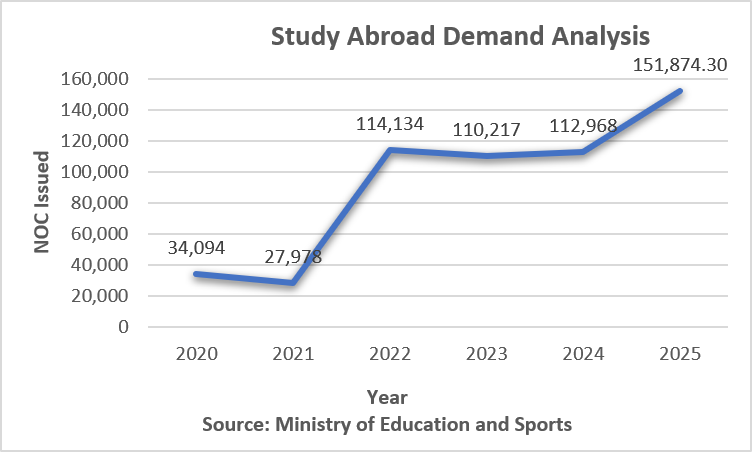
The following data illustrates the demand trend for study abroad between 2020 and 2025.
| Year | NOC Issued | Growth Rate |
| 2020 | 34,094 | – |
| 2021 | 27,978 | -17.94% |
| 2022 | 114,134 | 307.94% |
| 2023 | 110,217 | -3.43% |
| 2024 | 112,968 | 2.50% |
| 2025 | 151,874 | 34.44% |
Demand Analysis of Study Abroad in Nepal
The above data clearly demonstrates the growing demand for international education among Nepalese students. Despite temporary fluctuations caused by global events, the overall trend indicates a strong and sustained increase in overseas education demand. The following are the major analyses from the above data:
Impact of COVID-19 on Student Mobility (2020–2021)
In 2020, approximately 34,094 students obtained NOCs to pursue studies abroad. Although this represented a considerable number of students, the outbreak of the COVID-19 pandemic disrupted international education worldwide. Travel restrictions, border closures, visa processing delays, and uncertainty regarding university operations significantly affected student mobility.
Consequently, NOC issuance declined to 27,978 in 2021, representing a negative growth rate of 17.94 percent. Many students postponed their educational plans due to health concerns, travel limitations, and uncertainty surrounding international study opportunities.
Exceptional Recovery in 2022
The year 2022 marked a turning point for the study abroad market in Nepal. As international borders reopened and universities resumed normal operations, pent-up demand from previous years resulted in a dramatic increase in student mobility.
NOC issuance surged to 114,134 students, reflecting an extraordinary growth rate of 307.94 percent. This remarkable recovery demonstrated the resilience of Nepal’s international education market and highlighted the strong desire among students to pursue overseas education despite previous disruptions.
Market Stabilization During 2023–2024
After the exceptional growth observed in 2022, the market entered a stabilization phase. In 2023, NOC issuance slightly declined to 110,217 students, resulting in a negative growth rate of 3.43 percent.
This minor decline can be attributed to changing visa regulations, rising living costs in destination countries, increasing financial requirements, and economic uncertainties affecting student decision-making. However, the decline was relatively small, indicating that overall demand remained strong.
In 2024, demand regained momentum as NOC issuance increased to 112,968 students, representing positive growth of 2.50 percent. This recovery highlighted the continued attractiveness of international education among Nepalese students.
Strong Growth in 2025
The strongest growth was recorded in 2025, when NOC issuance reached approximately 151,874 students. This represents a significant growth rate of 34.44 percent compared to the previous year.
The substantial increase reflects growing confidence among students and parents regarding overseas education opportunities. It also demonstrates the increasing importance of international qualifications in today’s competitive job market.
Key Drivers Behind the Growth of Study Abroad
Global Recognition of International Degrees
One of the primary factors driving study abroad is the global recognition of international qualifications. Degrees obtained from internationally reputed universities often carry greater value in the global job market and provide graduates with enhanced career opportunities. Students increasingly seek educational institutions that offer practical learning experiences, industry-oriented curricula, research opportunities, and international exposure.
Better Career Opportunities
Career advancement remains one of the strongest motivations for studying abroad. Many students view overseas education as a pathway to higher-paying jobs, professional growth, and international career opportunities. Graduates from foreign universities often gain access to global employment networks and acquire skills that are highly valued by multinational organizations.
Attractive Post-Study Work Opportunities
Many popular study destinations provide post-study work rights that allow graduates to gain professional experience after completing their education. Countries such as the United Kingdom, Australia, Canada, and Germany continue to attract Nepalese students due to their favorable post-study work policies and potential long-term career prospects.
Growing Awareness Through Digital Platforms
The widespread adoption of digital technology has significantly increased awareness of international education opportunities. Students can now access information regarding universities, scholarships, admission requirements, visa procedures, and student experiences through social media, educational websites, webinars, and online counseling sessions. This increased accessibility to information has encouraged more students to explore overseas education opportunities.
Rising Investment in Education
Education is increasingly viewed as a long-term investment by Nepalese families. Parents are willing to allocate significant financial resources toward their children’s education if it can improve future career prospects and earning potential. This growing willingness to invest in international education has contributed to the expansion of the study abroad market.
Expansion of Education Consultancy Services
The rapid growth of education consultancies throughout Nepal has made overseas education more accessible. Consultancies provide services such as career counseling, university selection, application assistance, visa processing support, scholarship guidance, and language preparation. These services simplify the study abroad journey and encourage more students to pursue international education.
Migration Aspirations Among Youth
For many students, studying abroad is not only an educational decision but also a pathway toward global mobility, professional development, and long-term settlement opportunities. This aspiration continues to contribute significantly to the growth of study abroad demand in Nepal.
Future Outlook
Based on current trends, the future of the study abroad market in Nepal remains highly promising. The increasing number of NOCs issued, rising awareness of international education opportunities, growing middle-class aspirations, and attractive post-study work pathways offered by destination countries suggest that demand will continue to grow in the coming years.
Furthermore, emerging cities such as Dhangadhi, Pokhara, Butwal, Nepalgunj, Chitwan, and Biratnagar are becoming important contributors to Nepal’s international education market. As educational awareness and accessibility continue to improve, study abroad demand is expected to expand beyond major urban centers, creating new opportunities for students and education service providers alike.
Overall, the demand analysis indicates that study abroad in Nepal is a rapidly growing sector with strong future potential, making international education one of the most influential educational and economic trends in the country.
Also Read:
Over 88,000 students obtain NOCs online in three years as system expands
Education or opportunity? Understanding the real drivers of student migration from Nepal