
Table of Contents
Introduction
The United Kingdom (UK) has long been one of the most preferred study destinations for Nepalese students seeking quality education and international career opportunities. Every year, thousands of students from Nepal travel to the UK to pursue undergraduate, postgraduate, and research degrees in globally recognized universities.
The UK is home to some of the world’s most prestigious universities, including the University of Oxford, the University of Cambridge, Imperial College London, University College London (UCL), and the University of Edinburgh. Degrees obtained from UK universities are internationally recognized and highly valued by employers, governments, and academic institutions worldwide.
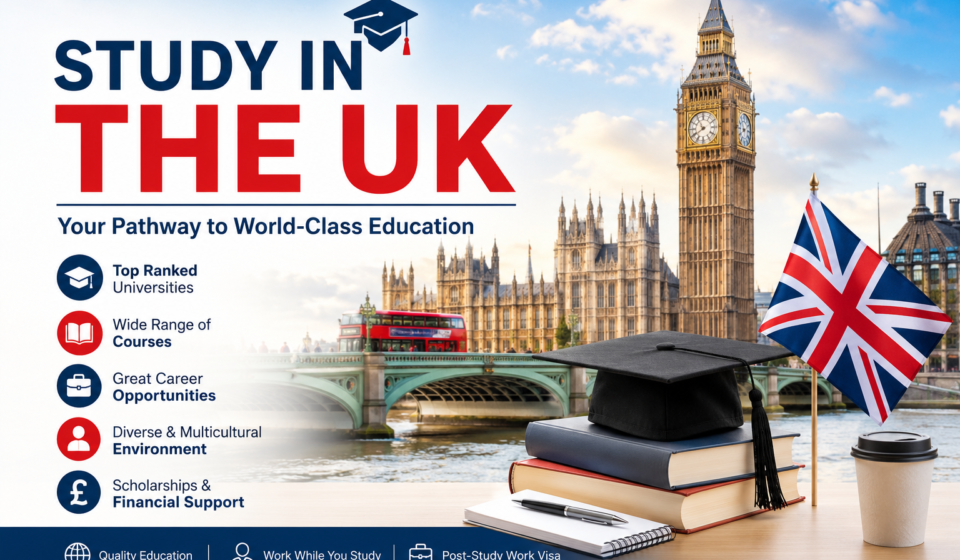
The popularity of studying in the UK among Nepalese students has increased significantly in recent years due to several factors, including shorter course durations, high-quality education, post-study work opportunities, multicultural exposure, and excellent career prospects. In addition, the UK’s Graduate Route Visa allows international students to stay and work in the country after completing their studies, making the UK an attractive destination for students who wish to gain international work experience.
This comprehensive guide explains everything Nepalese students need to know about studying in the UK, including university requirements, tuition fees, living expenses, scholarships, visa requirements, application procedures, and career opportunities after graduation.
Why Study in the UK?
Globally Recognized Degree
The UK consistently ranks among the world’s top education providers. Universities in the UK are known for their academic excellence, research facilities, innovative teaching methods, and strong industry connections. A degree from a UK university is highly respected globally and can significantly improve employment opportunities.
Shorter Course Duration
Compared to many other countries, degree programs in the UK are shorter. The shorter duration allows students to enter the job market earlier, save tuition fees, and reduce living expenses.
| Degree | Duration |
| Bachelor’s Degree | 3 Years |
| Master’s Degree | 1 Year |
| Ph.d | 3-4 Years |
Excellent Education Quality
The UK’s education system emphasizes the following:
- Practical learning
- Critical thinking
- Research and innovation
- Industry-focused curriculum
- Independent learning
Students develop skills that are highly valued by employers worldwide.
Post-Study Work Opportunities
The UK government introduced the Graduate Route Visa to allow international students to gain work experience after completing their studies. Graduates can stay in the UK for:
- 2 years after completing Bachelor’s or Master’s degrees.
- 3 years after completing a Ph.D.
This opportunity makes the UK particularly attractive for Nepalese students seeking international work experience.
Multicultural Environment
The UK hosts students from more than 180 countries. Studying in such a diverse environment allows students to:
- Build international networks.
- Improve communication skills.
- Gain cultural exposure.
- Develop a global mindset.

Popular Courses to study in the UK
Business and Management
- MBA
- International Business
- Marketing
- Human Resource Management
- Project Management
Computer Science and Information Technology
- Computer Science
- Data Science
- Artificial Intelligence
- Cyber Security
- Software Engineering
Engineering
- Civil Engineering
- Mechanical Engineering
- Electrical Engineering
- Renewable Energy Engineering
Healthcare and Public Health
- Public Health
- Nursing
- Healthcare Management
- Biomedical Science
Accounting and Finance
- Accounting
- Financial Management
- Investment and Banking
- Financial Technology (FinTech)
UK University Requirements for Bachelor’s Degree
Academic Requirements
Students must generally have completed:
- Grade 12 (+2)
- A-Level
- International Baccalaureate (IB)
- Equivalent qualification
Most universities prefer:
- Minimum 2.5–3.0 CGPA in +2.
- Strong academic performance in relevant subjects.
Highly ranked universities may require:
- 3.5 CGPA or above.
- Higher grades in specific subjects.
English Language Requirements for Bachelor’s Degree
Most UK universities require proof of English proficiency.
The commonly accepted tests include:
- IELTS Academic
- PTE Academic
- TOEFL iBT
- Duolingo English Test
Typical requirements are:
| Test | Required Score |
| IELTS | Overall 6.0, No band less than 5.5 |
| PTE | 58–65 |
| TOEFL | 72–90 |
| Duolingo | 100–120 |
However, requirements differ depending on the university and program.
English Language Test Waiver for Bachelor’s Degree
Many Nepalese students ask whether it is possible to study in the UK without IELTS.
The answer is yes, but only at certain universities.
Many universities may waive English language tests if students meet specific requirements.
Some universities consider:
- English subject grades in +2.
- English-medium education background.
- Internal interview or assessment.
Many universities may grant an English language waiver if the student has obtained a minimum ‘B’ grade in English at the +2 level.
However:
- The requirement varies from one university to another.
- Some universities may require a higher grade.
- Some universities may still request an English language test.
Therefore, students should always verify the latest English language waiver policy with the university before applying.
Study Gap Requirements for Bachelor’s Degree
One of the reasons why Nepalese students prefer the UK is the flexibility regarding educational gaps.
Many universities generally consider up to five years of a gap after completing +2.
Students with longer gaps may still be considered if they can demonstrate:
- Relevant work experience.
- Professional training.
- Business experience.
- Valid explanation for the gap.
Each university has its own gap policy.
UK University Requirements for Master’s Degree
Academic Requirements
Students generally need:
- Completion of a bachelor’s degree.
- Second-class degree or equivalent.
Most universities accept:
- CGPA of approximately 2.5 or above.
- Relevant academic background.
Certain competitive programs may require:
- Higher CGPA.
- Relevant work experience.
- Professional qualifications.
English Language Requirements for Master’s Degree
| Test | Score |
| IELTS | 6.5 Overall, No band less than 6.0 |
| PTE | 60–70 |
| TOEFL | 80–100 |
| Duolingo | 110–125 |
Requirements vary depending on the course and university.
English Language Test Waiver for Master’s Degree
Many UK universities provide English language waivers for postgraduate students.
The most common basis for the waiver is the following:
Medium of Instruction (MOI)
An MOI certificate is an official document issued by the college/university stating that the student’s previous degree was taught entirely in English.
Many universities may waive IELTS, PTE, TOEFL, or Duolingo if the following conditions are met:
- The student has completed a bachelor’s degree taught in English.
- The university accepts the MOI certificate.
- The student passes an internal interview.
Some universities may also require:
- A minimum ‘B’ grade in English in the +2 level.
- MOI certificate together with the English grade requirement.
The acceptance of MOI varies from one university to another and may change depending on the intake. Therefore, students should always verify the latest policy directly with the university.
Study Gap Requirements for Master’s Degree
Many UK universities are relatively flexible regarding study gaps. Generally, up to a five-year study gap after completing a bachelor’s degree is accepted by many universities.
Longer gaps may still be considered if supported by:
- Relevant work experience.
- Professional certifications.
- Business experience.
- Career progression.
Documents Required to Study in the UK
Academic Documents
- SEE Certificate and Transcript,
- Grade 12 Certificate and Transcript,
- Bachelor’s Transcript and Degree Certificate if applying for a master’s degree,
- Provisional Certificate
English Language Documents
- IELTS / PTE / TOEFL / Duolingo score report (if applicable)
- MOI Certificate (if applicable)
Personal Documents
- Valid passport
- Passport-sized photographs
- Updated CV or Resume
Supporting Documents
- Statement of Purpose (SOP)
- Letters of Recommendation
- Work Experience Certificates
- Financial Documents
- Tuberculosis (TB) Test Certificate
Step-by-Step Application Process
Step 1: Research Universities and Courses
Consider:
- University ranking
- Tuition fees
- Scholarships
- Location
- Career opportunities
Step 2: Prepare Documents
Gather all academic and supporting documents required by the university.
Step 3: Submit Application
Applications can be submitted through:
- University website
- UCAS (undergraduate)
- Education consultancy
Step 4: Receive Offer Letter
Universities issue:
- Conditional Offer
- Unconditional Offer
Step 5: Pay Tuition Deposit
Some universities require an initial deposit, and some universities don’t.
Step 6: Receive CAS
A Confirmation of Acceptance for Studies (CAS) is required for a visa application.
Step 7: Apply for Student Visa
Submit the following documents to apply for a student visa.
- CAS
- Passport
- Financial documents
- TB certificate
- Visa fee payment
Tuition Fees in the UK
Undergraduate Degree
The approximate annual tuition fee is £12,000–£20,000.
Postgraduate Degree
The approximate annual tuition fee is £13,000–£25,000. The approximate tuition fee is £18,000–£40,000 for MBA programs.
Estimated Expenses for Three-Year Bachelor’s Degree
| Expenses | Amount |
| Tuition Fee | £45,000 |
| Accommodation | £18,000 |
| Food | £7,200 |
| Transportation | £2,160 |
| Mobile & Internet | £900 |
| Miscellaneous | £3,600 |
| Grand Total | £76,860 |
Estimated Expenses for One-Year Master’s Degree
| Expenses | Amount |
| Tuition Fee | £15,000 |
| Accommodation | £6,000 |
| Food | £2,400 |
| Transportation | £700 |
| Miscellaneous | £1,000 |
| Grand Total | £25,100 |
The total expenses may vary depending on the university, city, and lifestyle.
Scholarships for Nepalese Students
Popular scholarships include the following:
- Chevening Scholarship
- Commonwealth Scholarship
- GREAT Scholarship
- International Excellence Scholarships
- University-specific scholarships
Scholarships may cover:
- Partial tuition fees.
- Full tuition fees.
- Living expenses.
Can Nepalese Students Work While Studying?
Yes, international students can generally work:
- Up to 20 hours per week during study periods.
- Full-time during official vacations and in PSW period.
Part-time work helps students gain:
- Work experience.
- Additional income.
- Professional networking opportunities.
Conclusion
The United Kingdom remains one of the best destinations for Nepalese students seeking quality education and global career opportunities. With internationally recognized universities, flexible admission policies, English language test waivers at some institutions, scholarships, and post-study work opportunities, the UK continues to attract thousands of Nepalese students every year.
Although studying in the UK requires careful financial planning, the long-term educational and career benefits make it one of the most worthwhile investments for students aiming to build an international future.
Also Read:
Study Abroad: Demand Analysis and Growth Trends in Nepal (2020–2025)
Education or opportunity? Understanding the real drivers of student migration from Nepal
Why Nepali students can’t wait to go abroad
Over 88,000 students obtain NOCs online in three years as system expands