

Introduction
Ireland has become one of the fastest-growing destinations for international education. Known for its world-class universities, welcoming environment, and strong economy, Ireland attracts thousands of students from around the world every year.
For many students, studying abroad is more than earning a degree. It is an opportunity to gain international exposure, develop valuable skills, and build a successful global career. Ireland offers all these advantages while providing high-quality education and excellent post-study opportunities.
If you are planning to study in Ireland in 2026, this guide will help you understand everything you need to know, including universities, courses, tuition fees, scholarships, student visas, and career opportunities.
Why Study in Ireland?
There are many reasons why students choose to study in Ireland.
World-Class Education
Ireland is home to several internationally recognized universities and institutes of technology. Irish degrees are respected by employers and educational institutions worldwide.
The Only English-Speaking Country in the European Union
One of the biggest advantages of choosing to study in Ireland is that it is the only predominantly English-speaking country in the European Union (EU). This gives international students the opportunity to earn a degree in English while living and studying in an EU member state.
Ireland’s membership in the European Union also makes it an attractive destination for global businesses and multinational companies. Many international organizations have established their European headquarters in Ireland, creating excellent career opportunities in sectors such as technology, finance, pharmaceuticals, and business.
For students, this means enjoying an English-speaking education system while gaining exposure to a dynamic European economy and an internationally connected job market.
Strong Economy and Job Market
Ireland is one of Europe’s strongest economies and is home to many global companies in technology, pharmaceuticals, healthcare, and finance. Several multinational companies have their European headquarters in Ireland.
Safe and Friendly Environment
Ireland is known for its welcoming people, rich culture, and safe environment, making it an attractive destination for international students.
Excellent Career Opportunities
Students who study in Ireland benefit from strong employment opportunities in various industries, especially in technology and business sectors.
Benefits of Studying in Ireland
Choosing to study in Ireland offers several advantages:
- Internationally recognized qualifications
- High-quality education system
- English-speaking environment
- Strong economy and employment opportunities
- Modern campuses and facilities
- Scholarship opportunities
- Excellent quality of life
- Multicultural environment
- Research and innovation opportunities
- Career-focused education
These benefits have made Ireland one of the most preferred study destinations in Europe.
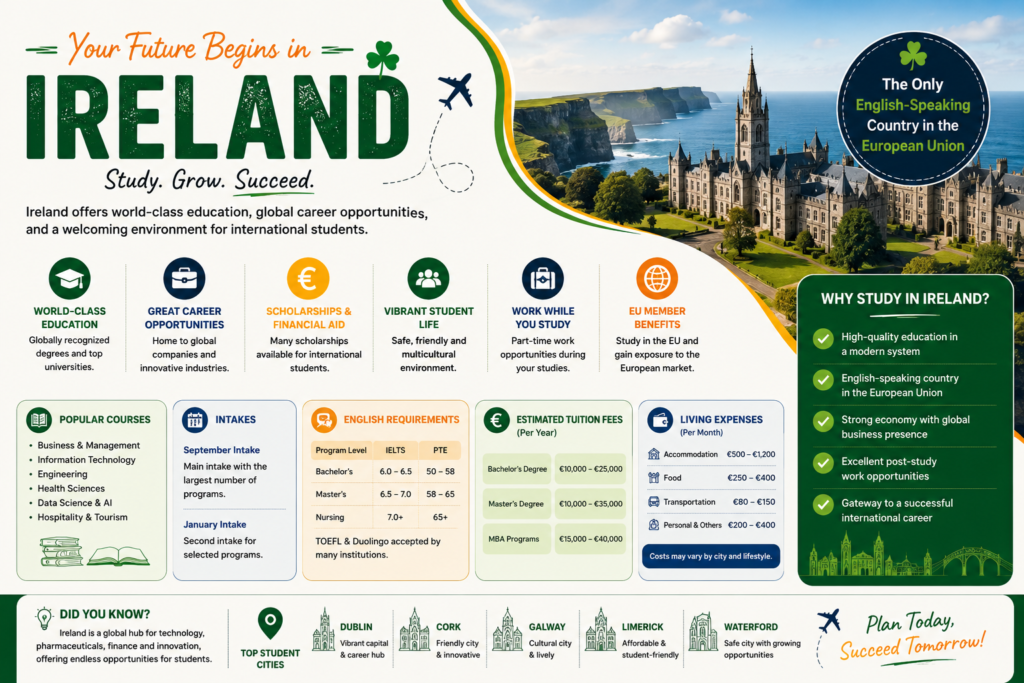
Popular Courses to Study in Ireland
Ireland offers a wide range of academic programs.
Business and Management
- MBA
- Accounting
- Finance
- International Business
- Marketing
- Business Analytics
Information Technology
- Computer Science
- Software Engineering
- Cyber Security
- Data Science
- Artificial Intelligence
- Cloud Computing
Engineering
- Civil Engineering
- Mechanical Engineering
- Electrical Engineering
- Biomedical Engineering
Health Sciences
- Nursing
- Public Health
- Pharmaceutical Science
- Healthcare Management
Hospitality and Tourism
- Hotel Management
- Tourism Management
- Event Management
Technology and pharmaceutical programs are particularly popular because Ireland is a major European hub for multinational companies.
Education System in Ireland
The Irish education system provides flexible learning opportunities.
Bachelor’s Degree
Duration: 3–4 years
Higher Diploma
Duration: 1 year
Master’s Degree
Duration: 1–2 years
Doctoral Degree (PhD)
Duration: 3–4 years
Irish universities focus on practical learning, research, and industry collaboration.
Intakes in Ireland
Ireland generally offers two major intakes.
September Intake
The primary intake and the most popular option for international students.
January Intake
A second intake available for selected programs and institutions.
Students planning to study in Ireland should begin preparing their applications several months in advance.
Requirements to Study in Ireland
The requirements to study in Ireland depend on the university and program.
For Bachelor’s Degree
- Completion of higher secondary education or equivalent.
- Good academic performance.
- English language proficiency.
For Master’s Degree
- Recognized bachelor’s degree.
- Relevant academic background.
- Work experience for certain programs.
- English language proficiency.
English Language Requirements
Most institutions require proof of English proficiency.
| Study Level | IELTS | PTE |
|---|---|---|
| Bachelor’s Degree | 6.0 – 6.5 | 50 – 58 |
| Master’s Degree | 6.5 – 7.0 | 58 – 65 |
| Nursing Programs | 7.0 or higher | Higher scores may be required |
Some institutions also accept TOEFL and Duolingo English Test scores.
Documents Required to Study in Ireland
Students generally need the following documents:
- Valid passport
- Academic transcripts and certificates
- English language test score
- Statement of Purpose (SOP)
- Resume or CV
- Recommendation letters
- Financial documents
- Passport-size photographs
- Work experience documents if applicable
Additional documents may be required depending on the institution and program.
Ireland Student Visa Process
Students who wish to study in Ireland generally need a student visa.
The process usually includes:
Step 1
Choose a university and program.
Step 2
Receive an offer letter.
Step 3
Accept the offer and pay the required deposit.
Step 4
Prepare financial and academic documents.
Step 5
Apply for the student visa.
Step 6
Submit biometric information and additional documents if required.
Step 7
Wait for the visa decision.
Providing accurate documentation and proof of financial capability is important for a successful visa application.
Cost of Study in Ireland
The cost of study in Ireland depends on the institution and program.
Estimated Annual Tuition Fees
| Program | Tuition Fee |
|---|---|
| Bachelor’s Degree | EUR 10,000 – 25,000 |
| Master’s Degree | EUR 10,000 – 35,000 |
| MBA Programs | EUR 15,000 – 40,000 |
Although tuition fees vary, many students consider Ireland a worthwhile investment because of its high-quality education and career opportunities.
Living Expenses in Ireland
Living expenses vary depending on the city and lifestyle.
Estimated Monthly Expenses
| Expense | Estimated Cost |
|---|---|
| Accommodation | EUR 500 – 1,200 |
| Food | EUR 250 – 400 |
| Transportation | EUR 80 – 150 |
| Internet and Utilities | EUR 100 – 150 |
| Personal Expenses | EUR 200 – 400 |
Dublin is generally more expensive than other cities in Ireland.
Scholarships for Study in Ireland
Several scholarships are available for international students.
Popular scholarship options include:
- Government of Ireland Scholarships
- University Merit Scholarships
- Research Scholarships
- International Excellence Scholarships
- Partial Tuition Fee Waivers
Scholarships can significantly reduce the financial burden of studying abroad.
Can Students Work While Studying?
One of the major advantages of choosing to study in Ireland is the opportunity to work while studying.
International students are generally allowed to work part-time during their studies according to visa regulations.
Part-time work helps students gain valuable experience and support some of their living expenses.
Best Cities to Study in Ireland
Dublin
Ireland’s capital city and home to several leading universities and multinational companies.
Cork
Known for its welcoming environment and excellent educational institutions.
Galway
Popular for its vibrant student community and cultural atmosphere.
Limerick
Offers affordable living costs and quality educational opportunities.
Waterford
A growing student destination with modern educational facilities.
Post-Study Opportunities in Ireland
Many students choose to study in Ireland because of the opportunities available after graduation.
Ireland’s growing economy creates strong demand for skilled professionals in:
- Information Technology
- Engineering
- Healthcare
- Pharmaceuticals
- Business and Finance
- Data Analytics
Graduates often gain valuable international work experience and improve their long-term career prospects.
Why Students Choose to Study in Ireland
Students decide to study in Ireland because it offers:
- High-quality education
- English-speaking environment
- Internationally recognized qualifications
- Scholarship opportunities
- Strong economy
- Excellent career prospects
- Safe and welcoming society
- Research opportunities
- Multicultural environment
- High quality of life
These factors continue to make Ireland one of the most attractive destinations for international education.
Conclusion
Choosing to study in Ireland can be one of the most rewarding decisions in a student’s life. The country offers excellent education, practical learning, a welcoming environment, and outstanding career opportunities.
However, proper planning is essential. Students should carefully choose their institution, understand the costs, prepare the required documents, and stay updated on visa requirements.
If you are planning to study in Ireland in 2026, start your preparations early and explore the opportunities available. With the right planning and guidance, studying in Ireland can become a life-changing journey that opens doors to academic and professional success.
Also Read:
Essential Guide to Study in the USA for Nepalese Students in 2026
Complete Guide to Study in the UK for Nepalese Students in 2026
Education or opportunity? Understanding the real drivers of student migration from Nepal
Study Abroad: Demand Analysis and Growth Trends in Nepal (2020–2025)
Study in Australia in 2026: A Perfect Guide for Students
Study in Canada in 2026: An Inspiring Guide for Students
Over 88,000 students obtain NOCs online in three years as system expands